
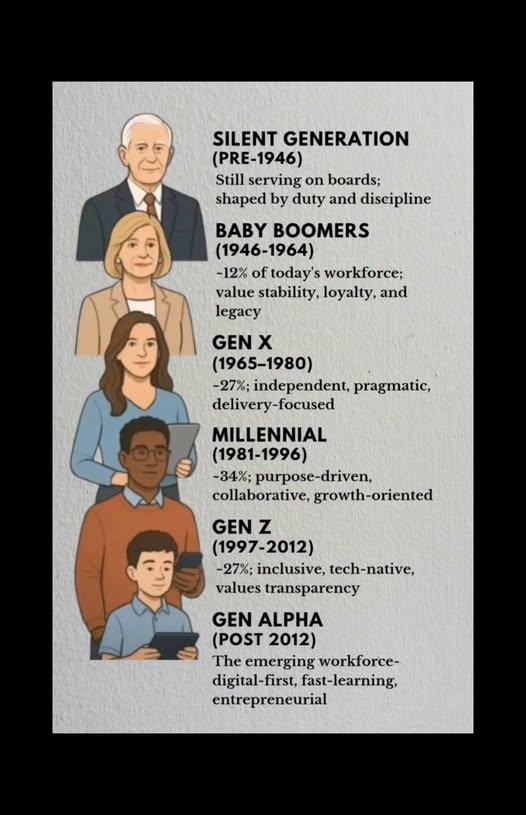
Many of the leadership programs that we’re privileged to co-create for clients across sectors have succession at their heart. But it isn’t the leadership shadow variety where junior employees have to prove culture fit and have to slot into the established mold. It’s focused on future fitness and what the organisation needs to remain relevant and effective.
There are currently many articles bashing Boomers (the generation born during the post war baby boom), for failing to retire and free-up room for subsequent generations to move into the seats they vacate.
They’re ill-advised.
This epoch simply doesn’t have to be framed as older workers “staying too long” or younger workers being “locked out.” That is a false conflict. Properly designed, this is one of the rare labour market dynamics where everyone can win.
Older generations bring judgement, context, client wisdom, leadership, and hard-won pattern recognition that simply cannot be fast-tracked. Enabling them to work longer creates continuity and stability. But their greatest value in the next phase of work is not just execution – it is transfer. They are uniquely positioned to manage succession, mentor, coach decision-making, and turn experience into organisational memory in a balanced and organised manner.
Younger generations, meanwhile, gain access rather than exclusion. They come through on the slipstream of experience: observing real decisions, contributing earlier, and building capability faster (if programmes are crafted in a systemic way), than isolated classroom training ever allows. This shortens the distance between potential and readiness, which is exactly what the current labour market claims to value.
Critically, this is not a one-way flow. When designed well, older workers refresh their own skills in the process – adopting new tools, fresh motivation, new ways of working, and future-fit practices alongside those they are developing. Learning becomes reciprocal, not remedial.
Experience stays relevant rather than calcifying.
Mutual respect replaces resentment.
The mistake organisations make is treating ageing, succession, and development as separate issues. They are not. They are part of one people system. Succession must operate at every level, development must be bite-sized and continuous, and roles must be designed to overlap generations rather than replace them dramatically.
An ageing workforce, when re-framed properly, is not a blockage. It is a bridge.
We know from experience that organisations which deliberately pair experience with emerging talent, allowing wisdom to travel forward while capability is refreshed in real time, will not only avoid the looming succession cliff. They will build deeper, more resilient leaders, and better prepared for whatever comes next by delivering impactful mentoring in waves of experiential energy at lower, middle and senior leadership levels.